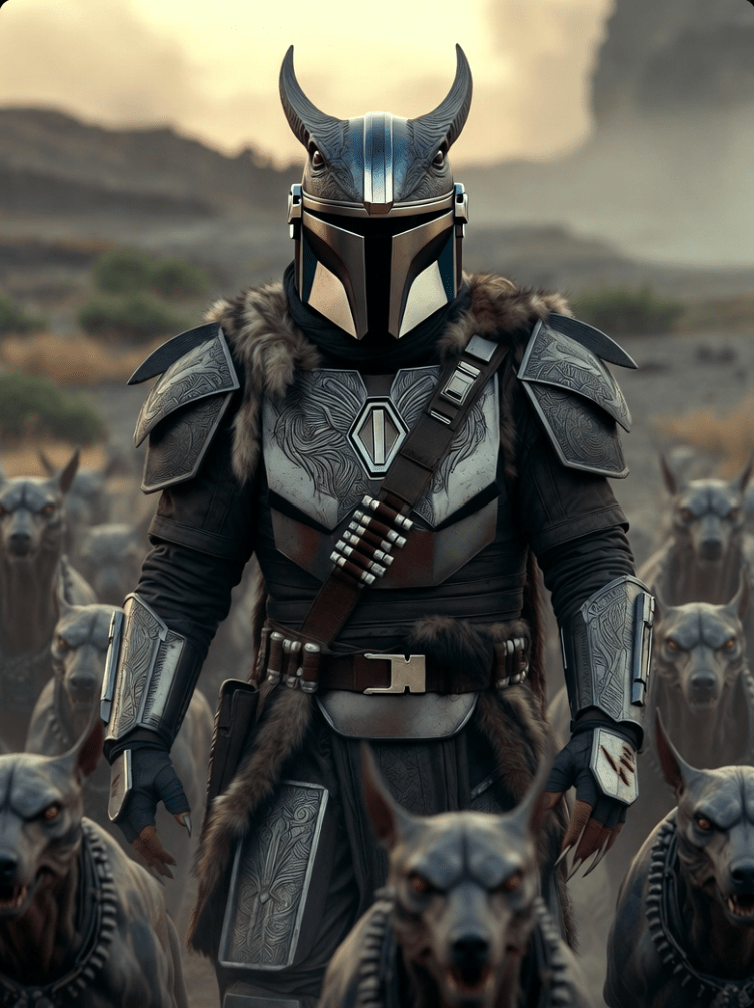
The Shev’Ur…The Ghosts of Mandalore
Old Republic Era
In the shadowed age before the Republic first charted its stars and numbered its years, when the galaxy was still a wild forge of fire and blood and the first Taung Crusaders descended upon the red world they would come to name Mandalore, a single betrayal rang louder than any beskar hammer or war cry. It was not a betrayal of clan against clan, nor of warrior against foe, but of the most sacred pact between flesh and fang, between the Baar, the essence perhaps, of the body and the eternal current that binds every living thing. That wound would birth a clan that stood apart from all others: Clan Baar’yc, the Shev’Ur Strill…the Ghost Packs, of Mandalore.
They would move through history, like whispers in the badlands, unseen yet felt in the marrow of every true Mando’ad who ever glimpsed their claw-etched armor or heard the low rumble of a Strill at heel. They swore no oaths to any Mand’alor, flew no banners at the great musters on the plains outside Keldabe, and claimed no seat in the clan councils where the likes of Clan Ordo, Clan Fett, Clan Vizsla, or Clan Kryze debated the fate of empires.
Yet, they embodied, utterly, the Resol’nare..the Six Actions that have defined the Mandalorian people since the first forge fires burned on Mandalore…millennia before the creation of the first Great Forge…and they did this more purely than any conqueror or councilor who ever wore the Buy’ce…the second skin…the Beskar armor of the Mandalorian People. They were not merely Mandalorians. They were Mandalorian: the primal foundation of armor and language, family and future, clan and call…forged in the Wild, guarded by the shadow of a betrayed demigod, and feared…even by those who commanded the stars themselves.
To the wider galaxy, Clan Baar’yc existed as something far beyond myth. Their name, when spoken at all, passed like a chill wind through the halls of the Jedi Temple on Coruscant, the shadowed spires of the Sith Empire on Dromund Kaas, the glittering salons of Republic senators, and the smoke-filled cantinas of bounty hunters on Nar Shaddaa. Smugglers who plied the Hydian Way swore they had seen ghostly ships vanish into hyperspace without a trace. Republic admirals filed classified reports of “Mandalorian phantoms” that struck fleets from within and left only green energy flares, as faint afterimages…a Legacy of Finality, writ large upon the endless canvass…of the Void. Even the lowest street urchin on Coruscant had heard the spacer tales: “Beware the Ghost Packs of Mandalore. They do not fight for glory or credits. They hunt the Force itself when its wielders dare to chain…what should run free.”
Jedi archivists labeled the Shev’Ur a forbidden legend, a cautionary footnote in holocrons marked “Do Not Seek.”…and Sith Lords who dared probe too deeply vanished without a trace, their last transmissions nothing but static and the distant howl of something older than the Dark Side. To galactic citizens…whether Core World diplomat, Outer Rim scavenger, or neutral trader…the Ghost Packs, the Shev’Ur Strill, were the ultimate embodiment of Mandalorian ferocity, a living reminder that some warrior cultures touched something far deeper than blasters or lightsabers.
Their military ethos of pack-hunting, close-quarters fury, and unbreakable loyalty was common to many warrior peoples across the stars. But the Shev’Ur, as embodiments of the Wild…that’s what they named it…the Force…were the ultimate expression of the Force as it was meant to be…what the Force, simply…is. Neutral. Primal. The living heartbeat of the galaxy itself, demanding unity between beast and warrior, never tamed, never twisted, never chained.
This is their epic.
And I…Gunboat of Mandalore shall tell of them…what little I have come to know over the long years…a tale that spans centuries…millennia, really…of War and Sorrow that has devastated my People.
You will not hear this tale sung in the halls of the Great Forge in Keldabe…for the Shev’Ur ever speak, only to the Pack. You will not find this tale recorded in the archives of the Jedi Temple or the Sith Empire, for those who sought the Shev’Ur out…none ever returned to write of them.
The Story of Clan Baar’yk, and the Shev’Ur Strill, lives instead in dawn chants…sung beside an Alpha’s fire…in the blood-scent of the hunt…and in the silent memory of every Baar’yc who has ever felt the Wild pulse through their veins. It is a tale of betrayal…and also of awakening, of isolation and unbreakable bond, of War…waged not with distance but with the intimate closeness of fang and breath.
Mine is the story of how Clan Baar’yc became the living heart of what it means to be Mandalorian…mythical, feared, and eternal…while secretly guiding their entire culture for millennia with an invisible hand that most Mandalorians, let alone galactic citizens, would never suspect.
Their tragedy is profound, for they bear the weight of the true Force alone, grieving every loss, every Alpha slain, every time they must withhold their greatest gift…or hunt those who, most egregiously, would reach, to tame what must remain free. But, in a sad way, their triumph is greater still. By guarding the Creed, the Six Pillars, and the Way from the shadows, they have ensured the Mandalorian people…and through them, endless echoes of the value of Honor…Family…Service, and even Freedom itself, across the breadth of the galaxy…endure as something true, even when the galaxy itself forgets what the Force was meant to be.
The Ancient Wound: The First Mandalore and the Betrayal of the Demigod
My story begins not in the recorded annals of the Old Republic, nor even in the oral histories of the Neo-Crusader wars that would later shake the galaxy under Mandalore the Ultimate. It begins in the time of the Taung…the gray-skinned warrior species who, according to the ancient epics, preserved in Mando’a verse, left their dying homeworld of Roon and conquered Mandalore in a cataclysm of fire and fang. The planet they found was a savage paradise of red deserts, jagged rift valleys, and volcanic calderas where mythosaurs roamed as living titans.
These colossal beasts were not mere animals, as so many in these latter days believe. Canon holds that the first Mandalore, the founder of the Mandalorian people, tamed the greatest and most powerful of the mythosaurs and rode it into battle, its skull becoming the eternal symbol of their culture. But the Shev’Ur Strill remember a deeper truth, passed down only in the private rites of Clan Baar’yc, chanted at dawn when the first light touched the badlands.
The mythosaurs were sentient beings of immense intelligence, Shapers of the raw Power that the early Taung had only begun to sense. One Taung huntress…a Force-sensitive warrior of the old blood named, in the clan’s whispered legends, the first to touch the Wild…reached beyond the crude divisions the galaxy would later call Light and Dark. She touched something…older…something neutral and eternal. She felt, experienced…the Wild. It flowed through soil and star, through fang and heartbeat, recognizing neither Jedi creed nor Sith ambition, only the perfect unity of beast and warrior. To the Shev’Ur, this Wild was the Force as it was meant to be…the galaxy’s living heartbeat, demanding partnership, never mastery.
The mythosaurs answered her call not with submission, but with recognition. Mind to mind, spirit to spirit, they forged a pact with other Force Sensitives of the Taung Warrior People…an Alliance…of equals. The titans would carry the worthy into battle only as partners, never as slaves. Together they thundered across the stars, and the name Mandalore shook the galaxy. The Taung Crusaders carved out an empire that made entire star systems kneel. Mythosaurs fought beside them as brothers and sisters in the Wild, their roars shaking the void itself. In those ancient days, before the Resol’nare was ever formalized, the bond between warrior and Natural World was the very soul of Mandalorian identity. Galactic legends would later echo this era in fragmented holorecords and spacer tales, painting the first Mandalorians as almost Superhuman…and the greatest of the Mythosaurs, as demigods who allowed the greatest Mandalorian Champions to ride them…as living mountains, into war…whispers that unknowingly preserved the Shev’Ur truth.
But victory soured into blasphemy.
After the Great Wars…when the last enemy banners fell and the first Mandalore stood triumphant atop a mountain of conquered worlds…he looked upon the Greatest of all the Mythosaurs and saw not a partner…but a trophy…Property…a symbol of his power. He kept the demigod in chains within the deepest vaults beneath what would one day become the site of Keldabe’s Great Forge. There, in the dark depths, the titan wasted away, its spirit severed from the Wild. Its final roar was not of rage but of grief…a sound that still echoes in the rift valleys of Mandalore on the darkest nights, a low, mournful howl that makes even the hardiest strill lower its head in reverence and causes seasoned warriors to pause mid-stride, feeling an ancient shame stir in their blood. To galactic citizens who heard the tale centuries later…through smuggled Mando’a fragments or drunken cantina stories…this betrayal became the root of Mandalorian ferocity: a culture born in grief, forever seeking to reclaim what was lost…for to the eternal horror of al Mando’ade…they realized only too late, they had doomed the bloodline of the Mythosaurs…to extinction.
From that day, a single Mandalorian bloodline swore an unbreakable vow: never again would they lend their power to any Mand’Alor, any Clan, or any cause that might repeat such desecration. They would guard the true spirits, and the memory, of the last of the mythosaurs, alone…reverent, uncompromising, and apart. That bloodline became Clan Baar’yc.
In the centuries that followed, as the Taung faded into legend…gradually becoming extinct themselves, Human Mandalorians…once slaves to the Taung…rose to carry the old fire. The last of the great human Champions, Force Sensitives all, that had ridden Mythosaurs into battle with their Taung Masters across the Galaxy…these became the Shev’Ur…and the Force ran strong with them. The last mythosaurs, in time…their spirits broken by sorrow…died, and the Mandalorians who had bonded with them…drifted…aimless…lost in their memories, and faded triumphs only they remembered.
And thus, in time…the Human riders of the Mythosaurs became a myth, just like the Taung, among the People of Mandalore, a whispered and half-remembered ancient terror across the galaxy. Someday…long centuries later, Mandalorian parents would tell their children, “The Ghost Packs watch from the badlands, waiting for the day the Wild calls them forth again.” Someday, young warriors on their verd’goten would sometimes glimpse a shadow in the distance…beskar etched with strill skulls fused into sorrowful mythosaur silhouettes…and return to camp with wide eyes, swearing they had seen the True Mandalorians. The clan’s isolation only deepened the legend. They were the ones who remembered the betrayal when all others had forgotten…just old stories.
The tragedy of Clan Baar’yc was born in that moment of betrayal by the first Mand’Alor, and has never left them. Every generation carries the grief of the demigod’s chains as their own. They watched from the shadows as other clans bent the Resol’nare to politics and conquest, knowing their refusal to join makes them outcasts…loved in myth, feared in rumor, but never truly embraced. Galactic citizens who encountered the tales in Republic libraries or Sith holocrons saw only the surface: a mysterious Mandalorian sect that struck like phantoms and vanished. None understood the deeper wound…the Shev’Ur, the Bound Mandalorians, ferocious conviction that any who sought to tame the Wild were abominations worthy of hunting. When a Sith scholar once attempted to bind the spirits of powerful beasts in a forgotten temple, a Shev’Ur pack hunted him across three systems, leaving only a circle of fang-marked bones and a single green flash of Wild Energy. The story spread as a ghost tale among smugglers, reinforcing the clan’s reputation as the galaxy’s most primal Force hunters.
Yet this very isolation is their triumph…for by refusing to lend the Wild to any throne, they have preserved the Creed pure for millennia. The Six Pillars stand unbent because the Shev’Ur live them alone, a silent bulwark against the corruption that felled the greatest of the mythosaurs. In the minds of galactic citizens, the Ghost Packs became the ultimate expression of what the Force truly is…untamed, alive, demanding unity rather than control.
The Awakening of the Wild: Tor Baar’yc and the Birth of the Clan
It was in the aftermath of a skirmish between rival clans…ever echoing the endless feuds that defined the post-Taung era…that the Wild truly awoke, once more, within the bloodline. A warrior named Tor Baar’yc had lost his first pack to a rival clan’s ambush. They struck from distance with blaster fire and explosives, the very cowardice that would later become an abomination to the Shev’Ur. Tor knelt among the cooling bodies of his strills, six-legged predators native to Mandalore whose loyalty and pack-hunting instincts had been woven into Mandalorian culture for millennia. (Even in the later Clone Wars era, strills like Mirdalan would serve as faithful companions to warriors such as Walon Vau of Clan Skirata, though none outside the Shev’Ur ever suspected the deeper bond Walon, whom through sheer chance, and shared pain and sorrow, had forged.)
As Tor pressed his palms to the blood-soaked soil, something stirred beneath the stone. The Wild answered. He reached through the pain of his loss, and heard the galaxy breathe. He felt the pulse of every living thing for kilometers around…the scent-trails that crossed oceans of sand, the danger that trembled in the very pulse of the bedrock. Visions flooded him: the Mythosaur’s chains, the demigod’s final roar, the betrayal that had severed the Baar from the Wild. In that moment, Tor vowed to heal what had been broken, knowing the cost would be eternal solitude and the burden of guarding the true Force.
He began the hidden rites. In volcanic calderas where lava met ancient ore…places the Forgemasters of Keldabe would one day guard in sacred silence…Tor learned to infuse beskar with the Wild itself. The living metal no longer merely protected the body; it became an extension of his Baar. Plates hummed in resonance with flesh and bone. Scars told stories. Every claw-etch, every mythosaur silhouette scratched into the armor, was earned blade-to-fang, never from the coward’s distance. Tor spent years in solitude, perfecting the rituals. He would meditate for days without food or water, letting the Wild flow through him until his senses expanded beyond the human form. He could smell a rival clan’s approach from leagues away. He could feel the heartbeat of a strill pup before it even opened its eyes. The grief of the first betrayal weighed on him like beskar; every ritual a reminder…the Wild must never again be chained.
Tor was the first to bind mind and body with a new strill pack. He named his clan after the truth he discovered: Baar…body…fused forever with the Wild. Every warrior who followed would be Baar’yc: primal-bodied, their very blood and bone no longer merely their own but bound, spirit and sinew, to the pack and the living galaxy. The name itself became a declaration and a warning. To be Baar’yc was to reject the severance that had slain the greatest of the Mythosaurs. To be Baar’yc was to live as one baar with the Wild…the Force as it was meant to be.
The clan chose utter isolation. No seats at clan councils where Mand’alor the Ultimate would later rally the Neo-Crusaders against the Republic. No banners at great musters where Canderous Ordo would one day reunite the scattered clans after the Jedi Civil War. No sworn oaths to any Mand’alor, even as the galaxy burned in the Mandalorian Wars of 3976–3960 BBY. They wandered the wild places, glimpsed only when they willed it. Armor etched with claw and fang, strills padding at their heels like shadows given form…On the incredibly rare occasions when a Shev’Ur and their Pack would wander into one of the great domed cities of Mandalore, the crowds would part in profound, almost sacred, silence. Warriors who would face down Death Watch fanatics or Republic armies without hesitation simply bowed their heads. To speak unbidden to a Baar’yc was to risk misfortune. They were the last unbroken echo of the old ways, guardians of something older and fiercer than any creed.
Among the Mandalorian people, Tor Baar’yc became the stuff of campfire legend. Some said he was the reincarnation of the first huntress who had communed with the ancient mythosaurs. Others claimed his strills were descended directly from the demigod’s own pack. Mothers would tell their children, “If you wander too far into the badlands, the Ghost Packs may take you as one of their own…or, they may simply vanish you, as they do all who forget the old ways.” The myth grew with every generation. A young warrior from Clan Skirata, centuries later, would swear he saw a Baar’yc Champion during a hunt, moving with a strill as if they shared one body, and the tale would spread quietly through the clans, reinforcing the Shev’Ur’s mythical status. Galactic citizens who heard these stories through traders, or holodramas, saw the Shev’Ur as the ultimate Mandalorian ideal—ferocious pack hunters who embodied the Force in its purest, untamed form.
Only the most senior and gifted Mandalorian Forgemasters of Keldabe knew the whole of the truth. An ancient pact, older than most bloodlines and predating even the rise of the modern Mandalorian clans, between the Shev’Ur and the Forgemasters, bound them in silence. The Baar’yc brought raw ore alive with the Wild; the Forgemasters returned armor that sang with invisible power. Whenever a Baar’yc Shev’Ur appeared at the Great Forge…slipping through the shadows of Keldabe’s spires like a ghost…the great Smiths of the Mandalorian people bowed… and spoke no word. Not once in millennia did any Forgemaster break the silence, even as the galaxy convulsed through the Great Sith War, the Jedi Civil War, and the Dark Wars that followed. The Forgemasters became the clan’s only bridge to the wider Mandalorian world, their silence a sacred duty that only deepened the myth. And in those rare visits, the Alor of Clan Baar’yc would entrust the Forgemasters with their greatest gift: a handful of interfaces imbued with the Wild itself.
The Path Through the Wild: Senses, Hatreds, and the Dread of Emperors
Through the Wild, Clan Baar’yc sharpened their senses to superhuman keenness. Sight pierced starless nights, allowing a Champion to track a fleeing enemy across the dunes by the heat of their footsteps alone. Scent, not only of the mundane kind, but the spiritual scent of the Wild as well, tracked across oceans of sand or the vacuum-cold of space, letting packs anticipate ambushes days in advance. Awareness felt danger in the pulse of the soil itself, or in the micro-tremors of a Shev’Strill starship’s hull. Strength and dexterity turned every stride into the leap of a strill, every strike into the synchronized kill of the pack. They wielded this power for one purpose only…to deepen the sacred bond with their packs and to become one with the living galaxy…the Force…as they believed it was meant to be.
In war and the hunt, the Wild was their greatest weapon. During a hunt, a Champion and Alpha would merge senses so completely that the warrior could feel the prey’s heartbeat as if it were their own. They would stalk for hours or days, never rushing, closing only when the Wild demanded the intimate kill. In battle, the same principle applied. No ranged weapons. No impersonal death. The Shev’Ur would charge into the press of bodies, vibro-swords flashing, strills tearing through armor as if it were hide. The Wild amplified every sense until the enemy’s terror was as loud as cannon fire, allowing the pack to anticipate every feint, every desperate swing. A single Champion could lead a pack of twenty strills to dismantle a fortified position, moving as one baar’yc form, the Force-imbued beskar turning enemy fire into mere static.
And, in time,as they hunted across the galaxy…they developed an even deeper hatred…of Force ghosts, those unnatural abominations that cheated the sacred cycle of life, death, and rebirth. To the Shev’Ur, such entities were parasites upon the Wild, severing the baar from its rightful place in the eternal flow. Their attunement let them and their strill packs track these spectral horrors across any distance, especially in the raw Force-storms of Wild Space or ancient battlefields where the veil between Life and Death grew thin. In the eras of the Old Republic, when Sith spirits and Jedi echoes lingered on worlds scarred by the Great Hyperspace War and the subsequent conflicts, the Ghost Packs became silent hunters of the unquiet dead.
One legendary hunt involved a Champion named Renn Baar’yc, who tracked a Sith Force ghost that had possessed a Republic general during the Cold War era. The pack pursued the entity across three star systems, the Wild allowing them to sense its unnatural presence even through hyperspace. When they cornered it on a remote moon, the Champion and Alpha merged so completely that the ghost’s possession was torn from the host in a ritual of fang and blade. The story spread among the clans as a half-believed legend: “The Shev’Ur do not fight the dead…they devour them.”, they whispered.
Galactic citizens who heard the tale through bounty hunter guilds shuddered at the ferocity: the Ghost Packs did not debate the nature, the essence of the Force…they hunted those who perverted it.
The Sith Emperor Vitiate himself, the immortal architect of the Sith Empire during the Old Republic era, whose schemes would later echo into the Great Galactic War and beyond…he lived in quiet dread of them. He knew the secret of the Shev’Ur Strill of Mandalore from first-hand experience. He knew they could hunt his incarnations and possessed vessels no matter how cleverly he hid behind layers of ritual and contingency. This fear was one of the chief reasons he remained so carefully concealed, weaving plans so intricate that even after his apparent destruction, his unwitting servants continued his work…eventually contributing to the chains of events that led to the Glassing of Mandalore itself in later centuries. Vitiate would rather let empires crumble than risk drawing the Shev’Ur Strill from their badlands. In the clan’s oral histories, Vitiate is remembered as the ultimate coward, a being who cheated death yet feared the Wild’s judgment. To galactic citizens, the Emperors’ paranoia only fueled the legend: even the immortal Sith feared the Ghost Packs.
The most powerful Jedi and Sith Masters of the era were not ignorant of Clan Baar’yc. Whispers reached even the sealed archives of the Jedi Temple on Coruscant, and the shadowed councils of the Sith Empire, on Dromund Kaas. To those who truly understood the Living Force…or thought they did…Clan Baar’yc was akin to the Witches of Dathomir: primal wielders of a raw, untamed current that the Shev’Ur named the Wild. They were neither Light nor Dark, yet incredibly dangerous when angered or provoked. Their power did not seek thrones, empires, or dominion; it existed only to preserve the sacred balance of beast and warrior, pack and Wild. The Shev’Ur considered any Force user who sought to tame the Wild an abomination…Jedi who tried to “civilize” it, Sith who tried to twist it for power. When such arrogance appeared, the Ghost Packs intervened with ferocious finality, hunting the worst offenders across systems with the same relentless pack unity they brought to every battle.
And so the galaxy’s greatest Force users left them in peace.
The reason was written in unmarked graves and silenced transmissions: no Jedi or Sith Master who ever sought them out has ever returned.
Jedi Master Vara Korr, a revered seeker of ancient Force traditions in the immediate aftermath of the Mandalorian Wars, led a small enclave of scholars and knights into the rift valleys of Mandalore. Convinced she could “civilize” the Ghost Packs and bring their knowledge of the Wild into the Jedi Order as a tool for peace, she came with lightsabers drawn and words of enlightenment. For three nights the packs tracked them—not with blasters or bombs, but with the primal closeness of the Wild. Vara’s final transmission was a scream cut short by the synchronized leap of an Alpha strill and its Champion. Her enclave was found weeks later: bodies arranged in a perfect circle around a single mythosaur silhouette scratched into the stone, every lightsaber shattered, robes torn only by fang and vibro-blade. No wounds from ranged weapons—only the intimate marks of the hunt. The Jedi Council marked the incident as “Lost to the Mandalorian wilds” and never spoke of it again, though some Padawans whispered of the “Mandalorian ghosts who hunt the Force itself.” The story eventually reached the Republic and Imperial holonets as a cautionary tale of “untamed Mandalorian cults,” deepening the clan’s galactic reputation as ferocious protectors of the true Force.
And there was Darth Vexor, a Sith Lord of Vitiate’s inner circle during the height of the Empire’s cold war with the Republic, who chose to defy even his Emperor’s quiet warnings…utterly obsessed with augmenting his essence through primal rites…granting him a vessel strong enough to rival Vitiate’s immortality. He descended upon a known Strill hunting ground with a cadre of dark-side assassins. He wielded Force lightning meant to shatter the “primitive” Wild. The Ghost Packs did not flee. They merged…as one baar’yc form. Their Force-imbued beskar turned lightning into mere static against living armor. Vexor’s illusions of terror were torn apart by senses sharpened across oceans of scent and soil-pulse. His last moments were spent staring into the eyes of an Alpha strill as the pack closed in…close enough to taste blood, close enough to share breath. Only a single gauntlet remained, still crackling with dying dark-side energy, nailed to a thorn-tree as a marker. Even Vitiate, upon learning of it, chose silence over vengeance, ordering his servants to avoid the badlands at all costs. Galactic whispers turned the incident into a legend of Sith hubris punished by the Wild.
And then came Jedi Master Elandor Voss, a high-ranking member of the Jedi Council in the waning years of the Old Republic, He mounted a “diplomatic” expedition with two Padawans and a squadron of Republic scouts. Convinced the Shev’Ur Strill’s hatred of Force ghosts made them a threat to Jedi teachings on the afterlife and the natural order, he sought to confront the clan’s Alor and demand they submit their “heretical” Wild practices to Jedi oversight. The Shev’Ur answered with First Contact. The packs emerged from the mists like living shadows, Alpha and Champion leading the charge in perfect unison. Voss’s lightsaber never left his waist; the Wild’s awareness had already mapped every heartbeat in his party. His Padawans were found alive but broken…somehow stripped of their connection to the Force, whispering only of “the howl that severs the soul from the baar.” Master Voss himself simply vanished into the rift, never to be seen again. The Council filed this report, too, as “Lost to the Mandalorian wilds” and sealed it away, though the incident only added to the mythical aura surrounding the Ghost Packs.
Republic citizens read redacted versions in classified briefings, calling the Shev’Ur “the galaxy’s most dangerous heretics.”
And these, dear reader, were merely private reckonings. The galaxy would bear witness only once, in the cold void where even the stars themselves seemed to hold their breath…to the True nature of the Shev’Ur Strill.
The Shev’Ur Strill Take to the Stars: The Birth of the Ghost-Strill
When the Shev’Ur took to the void—first during the scattered skirmishes that followed the Mandalorian Wars, and later in defense of their homeworld—they did so in vessels that mirrored their ground packs perfectly. These small, massively armored and heavily armed attack ships were called Shev’Strill…Ghost-Strill. Forged in the same volcanic rites as their beskar, the hulls were imbued with the Wild itself. Sensors slid off them like water from oiled hide; even the sharpest Jedi or Sith senses registered only the empty pulse of empty space. Conventional cloaking fields were crude toys compared to the living camouflage of the Wild.
The Shev’Strill did not rely on long-range torpedoes or impersonal turbolaser barrages. They stalked their prey exactly as the packs did: silent, patient, closing to the intimate kill. Heavily reinforced for ramming and boarding, bristling with vibro-rams, boarding harpoons, and close-quarters shatter-guns, they moved in coordinated hunter formations—never firing from afar, always merging with the enemy vessel to tear it open from within, blade-and-fang style. Each Shev’Strill carried a Champion pilot and their bonded Alpha strill in a specially warded life-pod. The Wild bond allowed the pair to feel every tremor of the ship as if it were their own baar’yc body. No blasters from afar. No impersonal death. Only the breath, the blood, the closeness the Wild demanded. In the void, as on the ground, the pack fought as one.
A new hero emerged in these early void hunts: Sorn Baar’yc, a Champion who led the first recorded Shev’Strill raid against a Sith supply convoy during the Great Galactic War. Using the Wild to anticipate the convoy’s hyperspace exit, Sorn’s pack of five Ghost-Strill closed in perfect formation. The ships rammed and boarded simultaneously, the Champions and Alphas feeling the enemy hulls as extensions of their own bodies. The raid was over in minutes, the convoy left adrift with no survivors to report what had happened. Among Mandalorians, the tale became another layer of myth: “The Shev’Ur hunt in the stars as they do on the ground—close, silent, and without mercy.” Galactic citizens who heard the story through surviving crew manifests spoke of “Mandalorian ghost fleets” that appeared from nowhere and left only green energy scars.
The Living Resol’nare: The Six Pillars Embodied
Where other clans debated or bent the Six Actions to suit politics and war…adapting them during the Neo-Crusader conquests or the later civil strife that would fracture Mandalorian society…Clan Baar’yc lived them with unyielding clarity. They were the Resol’nare. To the broader Mandalorian people, this made the Shev’Ur almost mythical exemplars of the Creed, the ones who had never compromised. Warriors from other clans would sometimes leave offerings at the edge of the badlands…beskar scraps or strill pelts…hoping the Ghost Packs would accept them as a sign of respect, though none were ever acknowledged. Across the galaxy, the Shev’Ur were seen as the living embodiment of the Force in its purest state: the Wild, untamed and true.
Ba’jar – Wear Armor
Baar’yc beskar is not mere protection; it is an extension of the Wild itself. Force-imbued in secret volcanic rites, the plates hum in resonance with warrior and strill alike, turning glancing blows into caresses and amplifying every sense. Every scar, every claw-etch, every mythosaur silhouette tells the story of a life lived blade-to-fang. To wear it is to declare that armor is not a tool but a second skin—sacred, alive, and earned through the hunt. The same rites extend to the hulls of their Shev’strill ships, making vessel and warrior one baar’yc form. In the clan’s private tongue, the armor is not “worn”; it is grown into the body through ritual, a living second baar that sings with the Wild. During a legendary hunt led by Lira Baar’yc, a Champion whose pack faced a massive Zakkeg beast on Dxun, the armor’s resonance allowed her to feel the creature’s every muscle twitch, turning the battle into a dance of perfect unity. Galactic tales of such feats painted the Shev’Ur as Force incarnate.
Mando’a – Speak the Language
The clan’s tongue is pure and unbroken, woven with ancient pack-calls and Wild-infused commands that only a bonded strill can fully hear. They speak it not for outsiders but as ritual: dawn chants that bind warrior and beast as one mind, battle-songs that echo the mythosaur’s roar. In their isolation they have kept Mando’a alive as a living force, not a relic, even as the language evolved and spread among the broader clans during the Mandalorian Wars and beyond. The chants themselves became part of Mandalorian folklore, with some outsiders claiming to have heard distant howls that sounded like Mando’a spoken by the wind itself. To galactic citizens, these chants were the voice of the Wild itself.
Aliit – Defend Yourself and Your Family
For Clan Baar’yc, family is the pack…strill and warrior as true Vod, no different in flesh or spirit. Though they fight as one, preferring blade and fang in perfect unison, they will use Blasters, Blaster Rifles and other modern Weapons, when the need arises. They eat with the pack, sleep curled among warm fur and breathing bodies, and share every moment of life with spouses and children in the same circle. There is no separation; warrior and strill are equals in the Wild. The same holds in the void: each Shev’Strill Warship is crewed as a single pack, Champion and Alpha feeling the ship’s wounds as their own. A story passed among the clans tells of a Baar’yc family that adopted a lost foundling during a hunt, raising the child as one with the pack until the child’s first Mythos’tra’cyar bonded them forever. Galactic legends turned such tales into symbols of pure loyalty.
Verd’goten – Raise Children as Mandalorians
Every foundling or blood-born child undergoes the Mythos’tra’cyar…a coming-of-age that demands not only combat but perfect communion with a wild strill. They learn xenobiology, pack language, and the sacred history of the betrayed demigod while sleeping, eating, and fighting beside their first bonded beast. Clan Baar’yc raises warriors who understand that Mandalorian identity is not inherited but forged in the Wild, ensuring the next generation remains true to the old ways even as the galaxy changed around them. The ritual itself is mythical among other clans, with tales of children emerging from the badlands years later, forever changed, and bearing the marks and symbols of the Ghost Packs. To the galaxy, these children were living proof of the Force as unity.
Contribute to the Clan
Every hunt, every ritual, every silent visit to the Forgemasters serves the clan’s survival and the preservation of the Wild. They take no contracts for glory, accept no spoils of war. Their contribution is deeper: they remain the unseen guardians, tracking Force ghosts that threaten all Mandalorians, and keeping the mythosaur’s spirit free so that the culture itself may endure uncorrupted…living as the pack lives, without the crutch of ranged weapons or explosive distance, unless absolutely necessary.. In this way, they contribute to the entire Mandalorian people, though none outside the Forgemasters ever knew it. Their ferocious protection of the true Force ensured the Way survived.
Rally to Mand’alor (When Called)
Here Clan Baar’yc proves their devotion most profoundly. They have never sworn to any single Mand’Alor, yet they answer the call…in the direst of times…In the rarest moments of galactic peril, when the Wild itself stirs in warning…as it did during the Republic’s strike on the Hydian Way…the Shev’Ur Strill emerge…not to obey, but to lead by example. They answer the spirit of the Resol’nare itself, reminding every clan that true loyalty is to the old ways, not to any throne. To the Mandalorian people, these rare appearances were like the return of the mythosaurs themselves…proof that the old ways still lived. To galactic citizens, they were the Force made manifest in Mandalorian form.
Traditions of the Ghost Packs: Iron Rites and Eternal Bonds
Every pack…whether on the red sands of Mandalore or aboard a Shev’Strill in the cold void…is led by a Clan Baar’yc Champion and a single Alpha strill, the living heart of the unit. Normal strills fight and fall with grim frequency; they are family, but replaceable in the endless cycle of the Wild. The Alpha is the Champion’s truest brother or sister, the one whose spirit has merged most completely through the Force-imbued beskar and the Wild. The bond is transcendent: senses merged, hearts synchronized, a single living weapon that moves as one. They fight with the pack…vibro-swords, staves, and daggers flashing in the press of bodies and breath. Blasters, Rifles, and explosives only ever chosen as a last resort; The Shev’Ur dislike killing from a distance as they feel this impersonal form of Hunting severs the sacred closeness of the Wild. Blood and Beskar…Fang and Claw.
The Strill’kyr’yc—the Penultimate Reckoning
Only when an Alpha is slain does this ritual activate. The Champion kneels, the only thing in life that will make them bend the knee, before the entire clan and recites the names of every bonded ancestor while the assembled Shev’Ur Strill listen. To survive the death of your Alpha…to have allowed your truest brother or sister to perish…is the ultimate failure. Normal strills die; Alphas fall only in the rarest, most cataclysmic moments. The loss of a single Alpha is a wound felt by the whole clan, a blow to their collective strength and a reminder of the mythosaur’s betrayed freedom. If both the Champion and the alpha are slain, the bodies are burned together on a pyre of wild thorns so their spirits may rejoin the demigod, forever free. The ritual itself is so revered that even other Mandalorians who somehow witnessed it (a near-impossible feat) would speak of it in hushed tones as the ultimate expression of Mandalorian honor. This grief is the clan’s constant tragedy: every Strill’kyr’yc is a fresh wound from the first betrayal, yet they perform it without hesitation, triumphing in their refusal to let the Wild be cheapened by distance or ease. Galactic tales of the green energy that accompanied such rites only added to the Shev’Ur’s fearsome aura. If a Champion survives, they are exiled, stripped of their Beskar, and cast into the Badlands, alone and unarmed, to fend for themselves as pennance…some return…some.
First Contact…a Sacred duty
No other Mandalorian may engage the enemy before a Shev’Ur Strill has drawn blood or died trying…to shield the greater society and to keep the Wild’s secrets hidden in the chaos of battle. In one expanded tale, during a skirmish with Neo-Crusader remnants, a Baar’yc pack enforced First Contact so strictly that they held the line alone against overwhelming odds, buying time for other clans to regroup. The surviving warriors from Clan Beviin later swore they owed their lives to “the ghosts who fight as one.” When outsiders witnessed such ferocity, they understood why the Shev’Ur were called the Defenders of the True Force.
Mythos’tra’cyar…the Ritual of Dawn
All Warrior cultures have various rituals…but there are none who cherish such grueling daily trials, as the Shiv’Ur of Clan Baar’yc…bonded sparring to first blood…and then…still injured and often in great pain…silent meditation to purge weakness and draw closer to their demigod.
I have seen many depictions of these warriors over the long years…Beskar embellished with precious metals and gems…loud and vibrant colour that is the norm for all other Mandalorian Clans…
The beskar of the Shiv’Ur bears only natural color…simple earthy browns and quiet blacks, forest greens, sometimes…the only other decoration…etching with strill skulls fused into sorrowful mythosaur silhouettes…and the real scars of battle.
In private rites they recount the first Mandalore’s betrayal, vowing never to repeat it…living, eating, sleeping, and fighting as one with the pack, exactly as the Wild intended. These rites are the heart of the clan’s mythical status; outsiders who caught glimpses described them as “the dance of the true Mandalorians,” a living embodiment of the Resol’nare. The tragedy lies in the endless cycle: every dawn chant renews the grief of the betrayed demigod, yet every ritual is a triumph that keeps the Creed alive for a people who will never know the cost. To galactic citizens, the Shev’Ur were the Force in its primal glory…ferocious guardians who hunted any who would seek to tame…to own…it, as theirs alone.
The Hidden Legacy: The Technological Echoes of the Wild – How the Shev’Ur Shaped Mandalorian Pack Warfare Without Anyone Knowing
Though Clan Baar’yc remained apart, their influence on Mandalorian society ran deeper than any clan council or Mand’Alor decree. For millennia, the Mandalorian people at large had long recognized the devastating power of pack-hunting. From the earliest Taung crusades, warriors fought in tight, coordinated groups…strill-inspired formations that emphasized close-quarters fury, synchronized strikes, and unbreakable loyalty. The Resol’nare itself enshrined the pack as family (Aliit), the hunt as contribution (Contribute to the Clan), and the intimate clash of blade and breath as the purest expression of Ba’jar.
Yet without the Wild, most Mandalorians could never achieve the transcendent unity the Shev’Ur lived every day. So they turned to technology—pure, beskar-forged ingenuity—to mimic what the Ghost Packs embodied naturally.
The Forgemasters of Keldabe, bound by their ancient pact, became the silent conduit. Over centuries, they subtly guided Mandalorian engineers and armorers with concepts “gleaned from old Taung records” or “inspired by ancient strill lore.” No one ever suspected the true source. The Shev’Ur never claimed credit; they simply ensured that the Way endured. In this way, Clan Baar’yc became the hidden architects of Mandalorian military culture, the Creed, the Six Pillars, and the entire Mandalorian Way…shaping society from the shadows while remaining mythical ghosts to the very people they guided. Their tragedy is the loneliness of the gift-giver: they watch their people thrive on borrowed strength, knowing that revealing the truth would risk the Wild’s corruption. Their triumph is the quiet victory of preservation: by controlling the flow of the Wild, they have kept the Creed pure across ten thousand years of war.
The first echoes appeared in the post-Taung era, when early Mandalorian smiths began experimenting with rudimentary battle droids designed to fight in “strill packs.” These primitive machines moved in tight formations, their simple AI programmed to anticipate one another’s movements the way Alphas and Champions merged through the Wild. Legends among the clans spoke of “mechanical strills” that never broke rank, never fired from distance unless the pack closed first. These droids were tested in secret skirmishes, their performance whispered about in Keldabe forges. Unbeknownst to all but the Forgemasters, a Baar’yc Champion had once left a single data crystal at the Great Forge…anonymous, unmarked…containing observations of pack coordination drawn from a hundred hunts. The Forgemasters incorporated the patterns without ever naming the source.
By the time of the Mandalorian Wars, the technology had evolved into the first true war droids. The B-series line…culminating in the famous B3-S1, affectionately nicknamed “Bessie” by the Mandalorian commandos who deployed her…represented the pinnacle of this hidden legacy. Bessie and her sisters were not mere cannon fodder. They were engineered for pack-hunting: sensor suites that mimicked the Wild’s heightened awareness, allowing a squad of four B3 units to move as one coordinated entity, anticipating threats and striking in perfect unison. Their armor plating echoed Baar’yc beskar resonance, vibrating at frequencies that disrupted enemy targeting the way Force-imbued plates turned glancing blows into caresses. Commandos from clans like Skirata and Ordo would swear by their “Bessies,” treating them almost as Vod…Family…loyal, fearless, and bonded to the squad in a way that felt eerily alive. None knew that the core algorithms had been refined in secret by Forgemasters who had studied Shev’Ur hunt recordings for generations.
The greatest secret…the one treasured above all others by the Forgemasters, and guarded more fiercely than any beskar vault…was this: the heuristic mechanisms at the heart of every B-series droid were not technological alone. They were imbued with the Wild.
When the Alor of Clan Baar’yc came to the Great Forge in silence…once…sometimes twice, in every generation, or in times of dire need…the Forgemasters would bow deeper than to any Mand’Alor. The Shev’Alor would present a handful of small, crystalline interfaces, each one a fragment of Wild essence drawn from the clan’s most sacred volcanic rites. These interfaces were fused into the droid’s core heuristic processors during the final forging. The result was not programming. It was life. The B3-S1 units, the larger B7 Battle Mounts, the towering B9 Titan Mounts, even the ancient Basilisk war droids in their most refined forms…all…every last one…carried a spark of the Wild. This is the cause of the sentient behavior that made the droids legendary: Bessie units that would refuse to leave a fallen comrade’s side, Battle Mounts that adjusted their gait to comfort a grieving rider, Titan Mounts that seemed to “howl” in victory or sorrow. They were alive, in their own mechanical way…primal-bodied echoes of the baar’yc bond, the Force…as it was meant to be.
This was the greatest gift of Clan Baar’yc to the Mandalorian people. By sharing even a fragment of the Wild through technology, the Shev’Ur ensured that every pack could fight with something approaching the unity the Ghost Packs knew naturally. The tragedy of the gift is the clan’s constant vigilance: they gave only a few interfaces at a time, because they know how easily the Wild can be misused. A Sith Lord could twist it into a weapon of domination. A greedy clan could mass-produce it and cheapen the Resol’nare into factory-made slaughter. So…the Shev’Alors demand these droids be granted only to the greatest Champions of Mandalore…those who have proven themselves in the press of bodies, who live the Six Pillars of the Way without compromise. The Forgemasters honor this decree with rrigorously; to do otherwise would betray the pact older than most bloodlines.
When a B-series droid is destroyed in battle, the final flash is unmistakable: a surge of green Wild Energy, exactly the same hue that dimmed Vhe’ta Baar’yc’s beskar when her Alpha fell and she performed the Strill’kyr’yc. It is the Wild returning to the galaxy, a silent reminder that even the mechanical echo carries the soul of the betrayed demigod. Mandalorian commandos who witness this flare of energy…they speak of it in hushed tones… “the green fire of the old ways”…never knowing its true source. The Shev’Ur watch from afar, grieving every such loss as another small death of the Wild they guard, yet triumphant that the Creed endures through their sacrifice.
Larger variants followed the same path. The B7 “Battle Mount” series…massive quadrupedal droids built to carry warriors into the fray…these were direct technological echoes of the mythosaur pact. These hulking machines could be ridden like living titans, their AI programmed for “partner” mode: the rider and mount shared sensor feeds, the droid adjusting its gait and strikes to complement the warrior’s movements exactly as a mythosaurs once did with their Taung partners. In the Neo-Crusader campaigns, entire companies rode B7 mounts into battle, the packs of droids and riders moving with a coordination that rivaled the Shev’Ur on the ground.
Mandalorian tacticians marveled at how these mounts turned chaotic charges into synchronized storms of blade and cannon. “It feels like the old stories,” veterans would say around the fires, never realizing the stories were literal.
Even the ancient Basilisk war droids…the iconic flying battle mounts used by Mandalorians for centuries…carried the hidden imprint of the Shev’Ur. Their pack-hunting flight patterns, the way squads would dive and strike as one, the rider-mount neural interfaces that blurred the line between pilot and machine…all were refinements of concepts first observed and subtly seeded by the Ghost Packs. A legendary engineer named Jaster Mereel’s distant predecessor (in the clan’s private lore) once spent a single night in the badlands after a “chance” encounter with a lone Baar’yc Champion. The next morning he awoke with detailed schematics scratched into a beskar plate beside him. He never spoke of the meeting, but the Basilisk designs that followed revolutionized Mandalorian warfare.
The clans celebrated Mereel’s “genius.” Only the Forgemasters knew the truth…and the secret of the Wild-infused core that made each Basilisk feel almost alive.
By the Clone Wars era, the B3-S1 “Bessie” units had become legends in their own right.
Deployed by Cuy’val Dar trainers and elite commandos, these droids operated in four-unit packs that mimicked Shev’Ur Alpha-and-Champion bonds. Their AI used predictive heuristics refined over millennia from anonymous data drops at the Great Forge…algorithms laced with Wild essence that let the droids “feel” the battlefield the way the Wild let Champions feel the pulse of the soil. In one documented (yet never publicly credited) operation, a squad of Bessies and their Mandalorian handlers dismantled a Separatist outpost on a remote moon using tactics identical to a Shev’Ur First Contact raid: no ranged fire until the pack had closed, then synchronized boarding and close-quarters annihilation.
The commandos who survived spoke of the droids as “almost alive,” as if the machines carried a spark of something primal. They named their lead unit “Bessie” after the affectionate nickname given to the first B3 prototype, treating her with the same reverence a Shev’Ur Champion gave an Alpha strill.
The larger B9 “Titan Mount” variants…towering bipedal battle droids designed for siege warfare…took the mimicry even further. Crewed by a single warrior in a neural cradle, these machines functioned as mechanical mythosaurs: the pilot’s movements translated directly into the droid’s actions, creating a bond so seamless that the pair moved as one baar’yc form.
Squads of Titan Mounts would advance in pack formation, their heavy weapons reserved for the final, intimate breach. Mandalorian generals credited the innovation to “ancient Taung wisdom,” never suspecting that the true wisdom had been guarded in the rift valleys by the Shev’Ur for thousands of years.
This technological thread wove through every era. During the Hydian Way Reckoning, Vhe’ta Baar’yc’s nineteen Shev’Strill Warships were supported in the final boarding actions by a handful of prototype B3 units that the Forgemasters had quietly delivered to the clan weeks earlier—machines whose pack protocols had been tuned to the exact resonance of the Wild. The droids fought as extensions of the Ghost Packs, their movements so perfectly synchronized that Republic survivors swore the Mandalorians had “mechanical demons” fighting beside them. Vhe’ta herself never lived to speak of the droids, but in the clan’s private chants, the Bessies were remembered as “the echo that walks when the Wild cannot.” When one Bessie fell shielding her Champion, the green Wild Energy flashed across the bridge…mirroring the dimming of Vhe’ta’s own armor in her final Strill’kyr’yc.
Through these inventions, Clan Baar’yc became the hidden guide for the entirety of Mandalorian society, culture, the Creed, the Way, and the Six Pillars. The pack-hunting ethos that defined Mandalorian warfare…from the Taung crusades to the Clone Wars…was not born in forges or councils. It was born in the badlands, refined by the Shev’Ur, and gifted anonymously to the people who would never know the source.
The Resol’nare’s emphasis on family-as-pack, contribution through the hunt, and armor as a living second skin…all of it carried the invisible imprint of the Wild. Most Mandalorians had no idea. They celebrated their “technological superiority,” their “strill-inspired tactics,” their “unbreakable squad bonds,” believing these were purely Mandalorian innovations. In truth, every Bessie that charged into battle, every Basilisk that screamed across the sky in formation, every Titan Mount that stood as a mechanical demigod beside its rider was a silent testament to the Ghost Packs who had never sought glory, only the preservation of the old ways.
The Forgemasters maintained the secret with iron discipline. A single whispered word from a Baar’yc elder during a silent visit to the Great Forge could shape the next generation of droid AI. A data crystal left on a workbench at midnight would become the blueprint for neural interfaces that let rider and mount become one. The Shev’Ur asked for nothing in return…no credit, no contracts, no recognition. Their contribution was deeper: they ensured the Mandalorian people would always fight as packs, even when the Wild itself could not walk among them.
The tragedy is the clan’s isolation: they give the gift knowing it will be used in wars they refuse to join, watching their own people grow strong on fragments of the Wild while the Shev’Ur remain outcasts. The triumph is absolute: by rationing the Wild-tech and restricting it to the greatest Champions, they protect the Creed from corruption. No mass-produced armies of impersonal death. No Sith-twisted abominations. Only worthy packs, living the Resol’nare as the Shev’Ur intended. To galactic citizens, the B-series droids were simply the pinnacle of Mandalorian engineering; only the Forgemasters knew they carried within them…the True Force.
The Hydian Way Reckoning: Vhe’ta’s Sacrifice and the Price of the Wild
When the Republic, in its arrogance during the wars that scarred the Hydian Way trade route…a vital hyperlane that had seen countless Mandalorian and Republic clashes since the earliest conflicts…chose to strike at Mandalore itself and the broader Mandalorian Empire, Clan Baar’yc answered…not with oaths or banners, but with the Wild…and death.
Vhe’ta Baar’yc, called “The Silent Howl,” led the counterstrike. As Champion of her pack and one of the clan’s most revered Alor’ade, she took command of nineteen Shev’Strill attack ships…each one a Ghost-Pack translated into the cold void. For days they stalked the Republic armada like strills on the hunt, their Wild-imbued hulls rendering them invisible to sensors and the Force alike. The Wild allowed them to feel the enemy fleet’s movements as if the ships themselves were prey animals, predicting course changes and weak points with perfect precision.
When the moment came, the Shev’Strill did not engage at range. They closed in perfect formation, ramming, boarding, flooding enemy bridges with the synchronized fury of Champion, Alpha, and pack. Vibro-blades flashed in zero-g corridors; strills tore through bulkheads; the Wild amplified every sense until the enemy’s terror was as loud as cannon fire. The battle became legend among the few who survived to whisper of it. An entire Republic fleet—cruisers, frigates, supply convoys—reduced to drifting scrap by nineteen tiny Ghost-Strill vessels.
A handful of B3-S1 Bessie units, their cores freshly imbued by the Alor’s last visit, fought beside them…mechanical echoes that moved with the same primal unity. But the price was absolute. All nineteen Shev’Strill were lost. Vhe’ta’s own Alpha fell to a Jedi Knight’s lightsaber during the final boarding of the Republic flagship, the bond severing in a flash of green plasma that dimmed her Force-imbued beskar to black. Mortally wounded, hovering at the door of death, with the last whisper of her strength she performed the Strill’kyr’yc aboard the dying enemy bridge…opening her veins before the surviving Champions…she could not say the names of her ancestors herself…so they whispered them for her…and Vhe’ta smiled. The handful of Mandalorian Warriors who had come with the B3-S1 Droids…who would later share the tale in whispers…never quite believing their own memories…never truly understanding what they had seen on the bridge of that dying ship in the void between the stars…honor…legendary…In the embrace of smoke and fire, while the Shev’Ur whispered the names of every bonded ancestor… the Warriors remembered. They took her body, and her Alpha, to a quiet moon in Wild Space…and they burned their remains together…upon a makeshift pyre of wood, and wild thorns, releasing their spirits to rejoin the mythosaur…and the Wild
One Bessie unit, shielding her to the end, was destroyed in the same moment—its core releasing the same green Wild Energy that dimmed Vhe’ta’s armor, a flash that lit the bridge like the first dawn after the demigod’s betrayal.
The loss of nineteen Ghost Packs and their Ships was felt across every Shev’Ur Strill for a generation. Yet the Hydian Way Reckoning proved the clan’s nature in the harshest light: they ask nothing, give even less, and strike only when the Wild itself demands it. No contracts. No glory. Only the intimate, unforgiving closeness of the pack. Even as a secret society with no name in the Galactic annals…no identity beyond what the most powerful Jedi and Sith know in their bones…the Shev’Ur Strill are truly ghosts. But when the Republic chose to attack their homeworld and the Mandalorian Empire, Clan Baar’yc answered… with the Wild… and death.
Among Mandalorians, the Hydian Way became the ultimate proof of the Ghost Packs’ mythical power. Survivors from other clans would later claim they heard the Silent Howl’s battle-song echoing through the void, a sound that inspired entire generations to live the Resol’nare with renewed fire. The green flashes from fallen Battledroids were remembered as omens of the old ways, though none knew their source.
The clan’s tragedy deepened: another generation of grief, another reminder that their gift could not save their own. Their triumph: the Way endured because they gave it anyway. Galactic citizens who heard the survivors’ accounts called it “the day the ghosts of Mandalore saved the galaxy from itself.”
The Guardians Endure: Kira Baar’yc and the Eternal Watch
Even now, in the later years of the Old Republic…amid the gathering storms that would one day lead to the Clone Wars and the fall of Mandalore…Kira Baar’yc, scarred elder and current Shev’Alor, walks to the Great Forge in silence. Twice she has appeared at the ancient halls; twice the Forgemasters have bowed deeper than to any Mand’alor, for she carried the latest handful of Wild-imbued interfaces…precious crystals that would breathe life into the next generation of B3-S1 Bessies and Titan Mounts. Her pack has endured for over a century, carrying the memory of Vhe’ta’s sacrifice and the ancient wound of the mythosaur. Kira herself is the subject of new legends: a Champion who once tracked a Force ghost across Wild Space for seven years, her pack never faltering, the Wild guiding them like a living compass. When a Jedi seeker tried to “study” the Wild on a remote moon, Kira’s pack hunted him with ferocious precision, leaving only a circle of broken lightsaber shards and the green flash that now haunted Republic reports. To galactic citizens, Kira was the latest phantom in a long line of Shev’Ur legends…living proof that the Force had guardians who would never be tamed.
Clan Baar’yc remains the galaxy’s forgotten guardians…secretive, reverent, and utterly uncompromising. They seek no throne, no empire, no conquest beyond the next hunt. They do not follow the foundations of Mandalorian society. They are those foundations…armor and language, family and future, clan and call…forged in the Wild, guarded by the mythosaur’s shadow, and feared even by an immortal Emperor, the greatest masters of the Force, and entire Republic fleets. Through their hidden legacy of pack-hunting technology to the living spark of the Wild in every B-series droid, they have shaped the Mandalorian Way for millennia without ever asking for recognition. The Bessies that march beside commandos, the Basilisks that scream across the sky, the Titan Mounts that stand as mechanical demigods…all are echoes of the Shev’Ur Strill. The culture thrives because the Ghost Packs chose to guide it from the shadows, paying the price of isolation and grief so that the Creed might endure uncorrupted. To the galaxy at large, they were the ultimate expression of the Force…ferocious, primal, and true.
The Wild remembers. The packs endure. And the arrogant never return.
To the Mandalorian people and the wider galaxy, the Shev’Ur Strill are the eternal myth that keeps the culture…and the True Force…alive…in its darkest hours. They are the ghosts who remind every clan, every Force user, and every citizen what it truly means to be alive in the galaxy. And somewhere in the badlands, the dawn chants continue, the Alphas howl…In the Halls of the Great Forge…the Bessies stand ready to receive their secret spark of life…and the Ghost Packs?
They wait…silent, eternal, ready for the next time the Wild calls them forth…to hunt those who would dare to reach too far…
The abominations that would tame it.
Oya Baar’yc.
Oya Shev’Ur Strill.
Oya Manda.