Our “Iron Skin”
“There are two reasons why we have to wear armor. One is so that we don’t get killed too easily. The other is so that we all look Mandalorian, however different we may be from our brothers and sisters.”
―A Mandalorian mother to her daughter
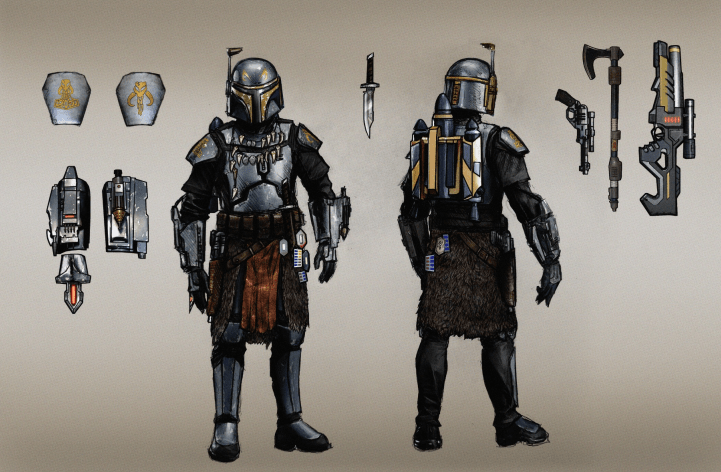
The single thing most often associated with the Mandalorians is the armor. In Mando’a, it was known as beskar’gam, or “iron skin“. In fact, just how central it was in a Mandalorian’s life cannot be overstated. Armor was greatly valued, especially if made from the near indestructible metal beskar. It was often passed down through generations, from one warrior to another. Aside from its defensive capabilities, this armor served another function: in a group formed from so many different species, often times it was only the similarities in their armor that displayed an outward sign of the culture that bound these individuals together.
The paint scheme of a Mandalorian’s armor occasionally represented a soldier’s state of mind. It could also signify their personal mission. For instance, sand-gold represented a quest for vengeance, while black indicated a desire for justice. Other colors had different meanings as well, e.g. blue signified reliability, green heralded a sense of duty, red was often used to honor a parent, gray was often used for mourning a lost love, and orange often showed a lust for life.
This was not always the case, however, and Mandalorians would sometimes decorate their armor in colors that meant something personal to them, or for which they simply held a personal preference. Whereas many soldiers preferred the inconspicuousness afforded by camouflage, Mandalorians believed in the saying:
“It’s one thing to see us coming….. but it’s another thing entirely to do something about it.”
Typical Mandalorian Armor Parts/Pieces
The Helmet/Basic Armor
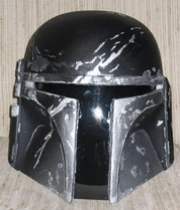
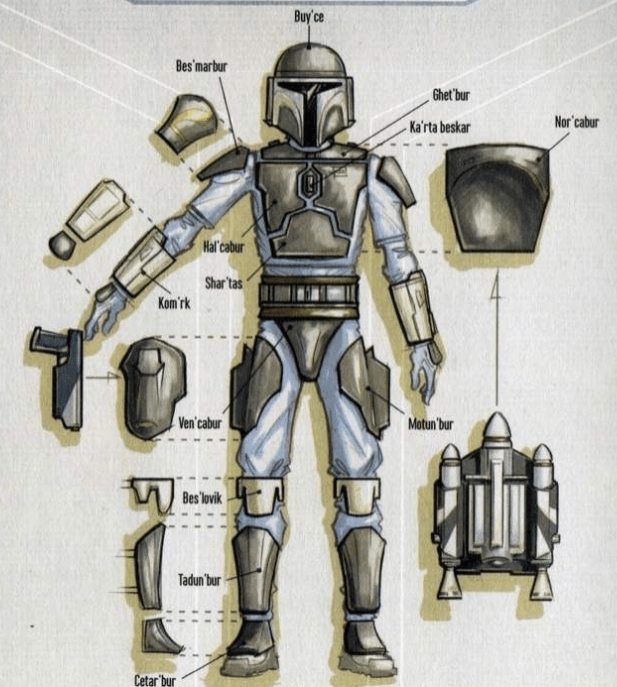
A typical Mandalorian helmet (Buy’ce) can control weapons, sensors, and a wearer’s jet pack with verbal commands. The environmental filter system can filter out poisons and contaminants as well as provide the wearer with a two hour reserve air tank. The helmet’s broadband antenna is capable of intercepting and unscrambling comlink and starship comm transmissions. Another common modification includes a macro-binocular viewplate with infrared scanner, magnifying up to 50 times. An infrared scanner magnifies light up to 100 times or displays heat gradations. At the top of the antenna is a rangefinder capable of tracking up to 30 targets from a distance of 100 meters. The rangefinder feeds data to a display overlay inside the helmet 41 which shows range and movement for targets in a 360 degree radius. The overlay also links to the rest of the armor’s weapons systems to display fire vector and range data.
While true Mandalorian armor is constructed from Mandalorian iron, this process is very time-consuming and is generally pointless when not in times of war. Therefore, most armor found is constructed from either durasteel or duraplast, allowing it to sustain a great deal of damage without degrading. A typical set of armor will also include two shoulderpads and two kneepads. Underneath the armor, the wearer fashions a power armor liner. This liner shirt had a micro energy field projector and two layers of thin ceramic plates in order to disperse physical and blast impacts thus reducing injuries. The power liner also gives the wearer increased protection from fire and acid as well as from intense heat and cold. The main clothing is a reinforced armor mesh battle suit/flight suit. The inner lining of the suit blocks poisons and corrosives for a period of time. A typical suit has pockets on the hips and thighs (at least one on each side).
Rocket/jet pack
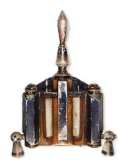
Usually, a Mandalorian Warrior will go into the field with a jet pack unless the mission dictates otherwise. The fuel tank holds enough fuel for one minute of continuous operation (20 three-second blasts). Each three second blast moves the wearer up to 100 meters horizontally or 7 meters vertically. The individual can reach a top speed of 145 kilometers per hour with a maximum range of two kilometers. Directional thrusters feature gyro-stabilizers to apply counterthrust for maneuvering and landing, depending on the style of jet pack used.
Vambraces (Kom’rk)-
“Mandalorian Vambraces? Where did you get these?”
“Try them on. Grappling line, paralyzing darts, repulsor. All designed to combat the abilities of the Jedi.”
―Sabine Wren and Fenn Rau
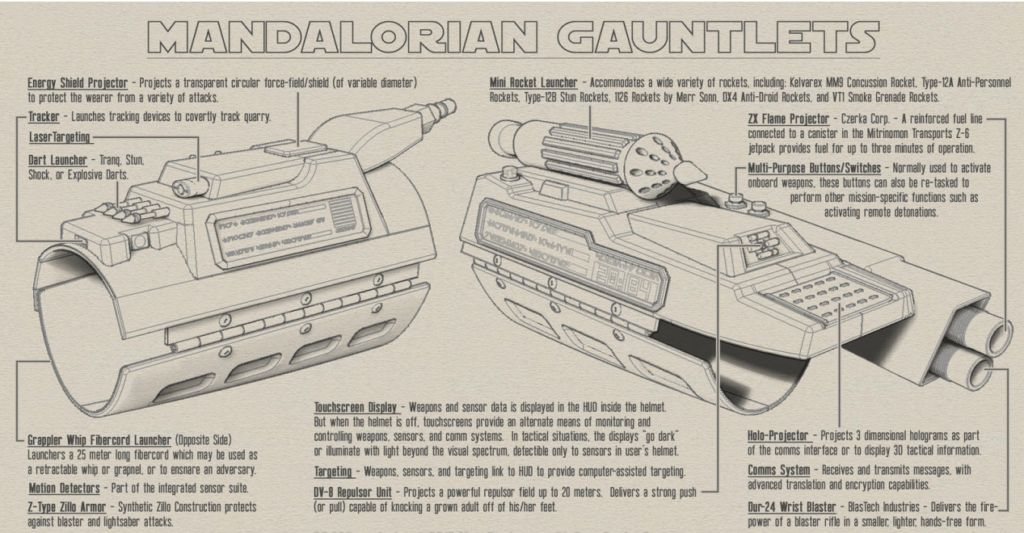
Mandalorian Vambraces were forearm brace-like devices designed to combat the Force abilities of a Jedi. However, they were also utilized for many other combative and non-combative purposes. Vambraces could be equipped with a large array of different weapons, such as blasters, darts, flamethrowers, rockets, vibroblades, and whipcords. The Mandalorians developed these vambraces alongside their armor as a reaction to the Jedi’s abilities encountered during the Mandalorian-Jedi War.
Weaponry
“I’m a Mandalorian…weapons are a part of my religion.”
-Din Djarin
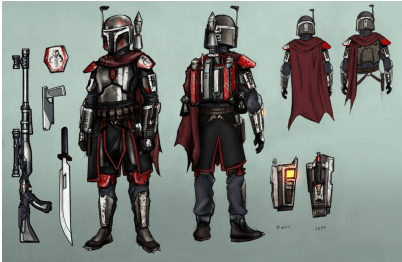
Typical Mandalorian Warriors were trained in all sorts of weaponry. These included everything imaginable from short-range vibroblades and hand-and-foot combat, to long-range blaster rifles. Others specialize themselves in explosives and even dedicated, long-ranged marksmanship. However, at a minimum, all Mandalorians are trained with hand-and-foot, vibroblades, pistol, and rifle combat methods.
The Science of Beskar – Mandalorian Iron
“Beskar is a uniquely resistant iron that develops a wide range of properties—and colors—in the hands of skilled metal-smiths. Depending on the alloy, it can take any form from plate, laminate, and wire to foam, mesh, micronized particles, and even a transparent film. Mandalorians jealously guard their beskar-working skills and refuse to sell the formulas for any price; attempts to reproduce finished beskar elsewhere have been disappointing. The ore is found solely on Mandalore, and only Mandalorians know how to work it to maximize its extraordinary properties.”
―Pilas Manaitis’s Strategic Resources of the Galaxy
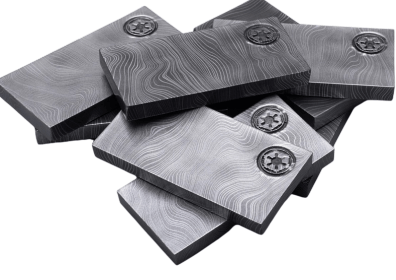
Mandalorian iron, also known by its Mando’a name of beskar, was an extremely durable iron ore whose only known source was the Outer Rim world of Mandalore and its moon, Concordia. The Mandalorian warrior culture that inhabited Mandalore mined their planet for beskar, using it in the creation of weapons, armor, and starships, as well as occasionally even selling the rare and valuable metal on the galactic market. The introduction of certain additives during the smelting process served to increase the strength of the natural ore, and Mandalorian metal-smiths jealously guarded the secrets of forging true beskar from outsiders, passing along the technique from one generation of metallurgists to the next, strictly within the Mandalorian community. A versatile metal, Mandalorian iron could be melded into multiple alloys and forged into various configurations.
Description
“By the Force! I thought a lightsaber could cut through anything. The walls are barely scratched. The only thing that can resist a lightsaber is…Mandalorian iron!”
―Exar Kun, regarding Freedon Nadd’s tomb
Mandalorian iron was rare throughout the galaxy, as the only known source for the ore was the planet Mandalore and its orbiting moon, Concordia, both located at the heart of Mandalorian space in the Outer Rim. Some speculated that beskar could be found in the other worlds of the Mandalore system, as well. The Mandalorians referred to the iron by the name beskar, and despite the word’s origins in the Mando’a language, it became common for even non-Mandalorians to refer to the element as such.
Mined from beneath the surface of Mandalore and Concordia, Mandalorian iron was one of the toughest metals known to science. Cherished for its incredible strength and durability, beskar was notable for being able to withstand blows from even a lightsaber, and was commonly thought to be nearly indestructible, making beskar far more prized than durasteel or cortosis.
The natural strength of beskar was amplified during the forging process, using techniques developed and closely guarded by Mandalorian metal-smiths, many of whom would rather die than reveal their secrets to outsiders. In the foundry, carbons were often added to the ore to create a molecular cage structure that allowed Mandalorian iron to be lighter than contemporary metals, while still retaining its incredible toughness. Without the addition of carbon, beskar was significantly heavier.
Repeated folding of Mandalorian iron during forging further enhanced its strength. Mandalorian metal-smiths combined beskar ore with several other metals to create multiple alloys capable of being shaped into various configurations, and were also responsible for affecting the final color of the finished beskar during the smelting process. When two pieces of beskar were struck together, the resulting sound was heavy and dull, more solid in resonance than the high tinny frequency produced from striking durasteel.
Usage
“If you’re worth that much, you can afford some better armor. Look at the state of you. All scrapes.” “We Mando boys like to show we’ve been in action. Anyway, this is top-grade beskar—full density, two percent ciridium, no fancy lamination or carbon-alloy.”
―Ny Vollen and Kal Skirata on the latter’s Mandalorian armor
A versatile metal capable of being combined into several alloys and molded into a number of forms, beskar became a common material in Mandalorian craftsmanship. Depending upon the composition of the alloy, Mandalorian iron could be rendered into solid plates, a laminate, wire, mesh, or micronized particles, even a foam, or a transparent film. Though materials such as durasteel and alum were commonly used in the creation of Mandalorian armor, Mandalorian iron was considered the most desirable choice for a soldier’s armor.
Armor forged of beskar could withstand blunt force, strikes from a lightsaber, and repeated blasterfire, though the force of the impact still transferred in part to the wearer. Mandalorian iron was also a common resource in the production of weapons: traditional Mandalorian sabers known as beskade were forged of Mandalorian iron, with the metal folded and struck repeated during the process to create the sturdy blades. Mandalorian kal knives were also cast from beskar iron. Micronized beskar was used in the creation of powerful crushgaunts, capable of breaking bone with ease, and bladed bes’bev flutes were crafted from Mandalorian iron, as well.
Beskar could be employed in the creation of lightsaber hilts in order to make them capable of resisting blows from an opposing blade, and Mandalorian iron crafted into hand-held shields could be used for defense and offense alike, allowing the wielder to strike their opponent or cut them with edges that have been honed to a razor sharpness. Ancient Mandalorian manacles were made of beskar, and the tough Mandalorian iron allowed them to compete with the advent of newer binder technology, such as force shackles and laser cuffs, for centuries. Many buildings in the New Mandalorian capital city of Sundari utilized beskar in their construction, and Mandalorian iron was used in the creation of the city’s prison cells, just as it had been for years in powerful beskar cages. Beskar was also often used in the construction of Mandalorian starships, including the likes of the Bes’uliik-Class starfighter, which featured an outer armored shell of micronized Mandalorian iron.
A History of Mandalorian Iron – Early history
“Now that you have abundant beskar, you’ll rearm. Roche may be outside of your sector, but the last time Mandalorians had plenty of beskar, the Mandalore sector became much, much bigger.”
―Sass Sikili
The ancient Taung progenitors of the Mandalorian culture were said to have been drawn to what became Mandalorian space by the lure of indestructible beskar ore, and discovered beskar sometime after their conquest of the planet Mandalore around 7000 BBY. The acquisition and use of Mandalorian iron was a contributing factor in the early expansion of the Mandalore sector. Mandalorian metal-smiths developed specific techniques and different methods for working the iron which they came to guard closely from outsiders, and passed down from one generation to the next. However, its incredible strength attracted the attention of many non-Mandalorians, and beskar quickly earned a reputation as one of the strongest metals known to science, and one of the most desirable elements in the galaxy; armies throughout the galaxy sought to obtain supplies of Mandalorian iron, and it became one of the most valuable metals metals on the galactic market. Attempts to purchase the knowledge of beskar iron-working from Mandalorian metal-smiths though the years had all failed, and all endeavors to replicate finished beskar without the aid of Mandalorian craftsmen had been met with similarly poor results.
Mandalorians furnished starships and constructed weapons with beskar, while the Jedi Master Arca Jeth utilized a heavy slab of Mandalorian iron to seal the tomb of the deceased Sith Lord Freedon Nadd on Dxun. The beskar door proved an impediment for the Dark Jedi Exar Kun, who was shocked to find that his lightsaber was rebuffed by the Mandalorian iron, and only gained access to the blocked tomb with repeated strikes of his saber at its highest power output. By the time of the Cold War between the Galactic Republic and the Sith Empire, Mandalorians had come to view beskar as the ideal material for crafting Mandalorian armor, and recognized the substantial benefits it provided when battling lightsaber-armed Force wielders, a viewpoint that lasted for generations. The Sith Lord Darth Rivan also made use of Mandalorian iron in his Sith fortress on Almas: the door to his ritual chamber and the floor of his lightsaber practice room were crafted from beskar, as was a chest Rivan used to hold his most valued Sith tomes. Another Sith, Lord Odion of the Grumani sector, had a throne of Mandalorian iron installed aboard the bridge of his flagship, the Sword of Ieldis, while some Sith warriors elected to wear heavy beskar armor as part of their apparel.
A Unique Mandalorian Resource
“Beskar is enormously strong, able to deflect blaster bolts and even lightsaber blades. Yet it is light and flexible, particularly when forged with carbon and ciridium. A skilled naur’alor can shape beskar into almost any form, manipulating its strength, color, and other properties. This knowledge is ours alone…” ―Tor Vizsla, founder and leader of the Death Watch
As time went on, Mandalorian iron became a prominent export from the planet Mandalore, fulfilling an economic niche for the Mandalorians on the galactic market. Following the Mandalorian Excision of 738 BBY that birthed the peaceful New Mandalorian faction, the pacifist sect made substantial use of Mandalorian iron in the construction of their capital city of Sundari, located in one of the white-sand deserts of Mandalore. Many of the city’s grand buildings and towers featured beskar in their architectural makeup, and durable Mandalorian iron was used in the creation of cells at the city’s prison. Some of the beskar utilized by the New Mandalorians came from breaking down suits of traditional Mandalorian armor the pacifist sect had relinquished upon embracing peace, re-purposing the material toward non-martial ends.
Before the Mandalorians ceased waging large-scale warfare, they turned to Mandalore’s moon, Concordia, seeking to uncover new deposits of beskar ore. Once an agricultural settlement, Concordia was transformed into a mining base by Mandalorian prospectors who scoured the moon for beskar. Ugly mines came to scar the surface of Concordia, and the mining operation was so extensive that the forests of Mandalore’s moon were nearly destroyed in the effort. The mining operations on Concordia eventually slowed to the point they were believed by the New Mandalorian government to have ceased altogether. However, the forces of the Death Watch—a violent and radical Mandalorian splinter group that opposed both the modern honorable ways of the warrior clans and the pacifism of the New Mandalorians—continued to maintain mining operations on Mandalore and Concordia in secret, acquiring beskar for weapons and armor. The Death Watch’s founder and leader, Tor Vizsla, touched upon these mining efforts and beskar in general in a manifesto he wrote entitled Ba’jurne Kyr’tsad Mando’ad.
Mandalorian police units continued to make use of ancient beskar-forged Mandalorian manacles during this time, keeping them as part of their standard equipment, as well as blast-proof beskar shields. The personal star yacht of the New Mandalorian leader, Duchess Satine Kryze, was furnished with beskar flatware used by passengers for dining.
By the start of the galaxy-spanning Clone Wars, the effects of the wide-scale beskar mining operation on Concordia began to fade, and the moon’s forests had begun to flourish again. At this time, the Mandalorian soldier Walon Vau possessed black beskar-forged Mandalorian armor in addition to a traditional Mandalorian beskad saber. Wad’e Tay’haai, Vau’s mercenary contemporary and a fellow Mandalorian member of the Cuy’val Dar—an elite group of training sergeants hand-picked to instruct the clone commandos of the Grand Army of the Republic—owned a bladed Mandalorian bes’bev flute cast from Mandalorian iron, painted the same violet color as his iron armor. Tay’haai’s good friend, and another member of the Cuy’val Dar by the name of Kal Skirata, wore armor that was a Mandalorian iron alloy containing two percent ciridium. Skirata’s armor lacked carbon in its composition, traditionally used to form a molecular cage structure that made beskar lighter, resulting in a significant weight increase. Around this time, Pilas Manaitis wrote at length on the attributes and advantages of Mandalorian iron in his work “Strategic Resources of the Galaxy”.
After the Galactic Republic was transformed into the Galactic Empire, Imperials began brokering negotiations with the clan chieftains of Mandalore in order to establish a garrison base on the planet and acquire the rights to mine for Mandalorian iron. An offer of eight hundred million credits was issued for exclusive beskar mining rights in the verdant Tokursh region of Mandalore, and the MandalMotors company was solicited to refurbish old prison ships and construct new ones with Mandalorian iron enhancements. In addition, requests were made to acquire specialist beskar equipment including manacles, holding cages, and security doors. However, as time passed, relations between the Empire and Mandalore changed from cordial to hostile: Mandalore was taken over by the Imperials and its people enslaved. The Empire strip-mined Mandalore’s shallow veins of beskar ore, shipping a significant amount offworld before Fenn Shysa and the Mandalorian Protectors were able to liberate Mandalore from the Empire. Around this same time, the Sith Lady Lumiya used Mandalorian iron to construct portions of her lightwhip.
In 24 ABY, at the four-hundred-twelfth Proceedings of Galactic Anthropology and History at the Brentaal Academy on Brentaal IV, historian Vilnau Teupt gave a keynote speech entitled “Industry, Honor, Savagery: Shaping the Mandalorian Soul.” During the speech, he discussed the place of beskar in the vast history and culture of the Mandalorian people.