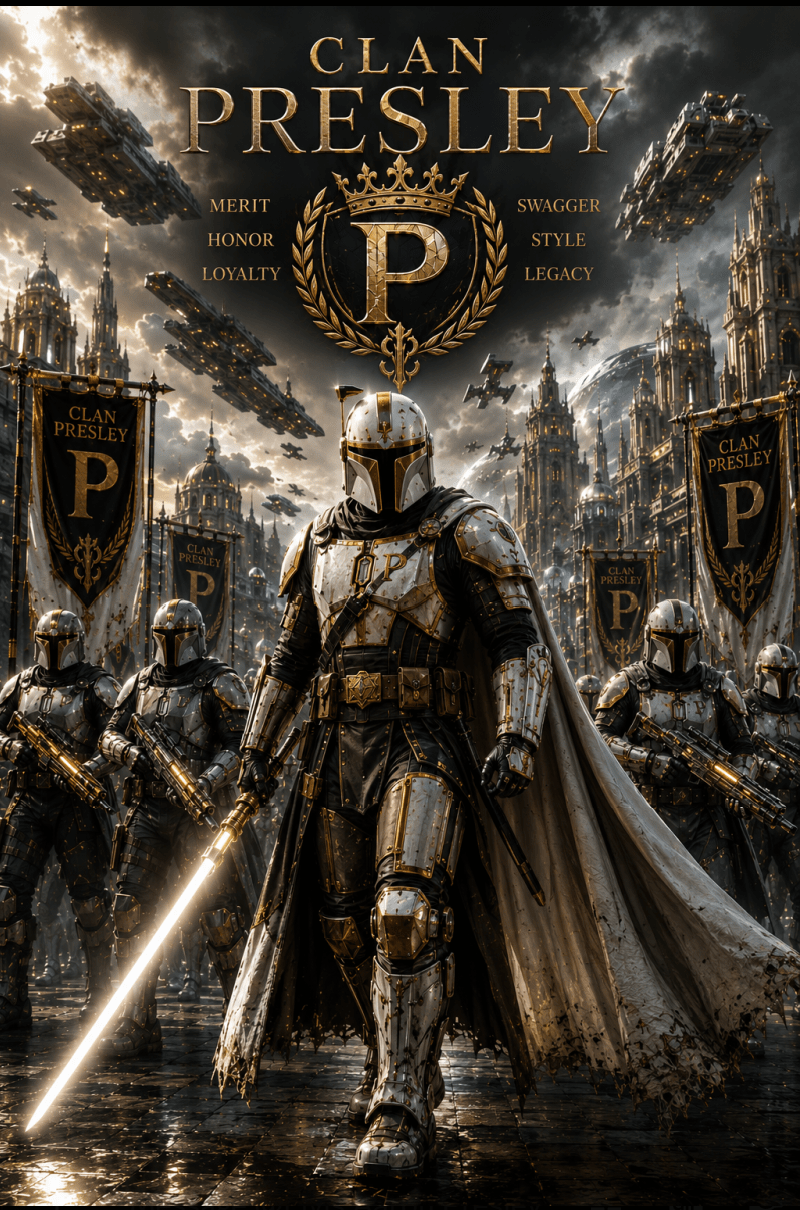
An Excerpt from the Chronicles of MANDO
“Not a throne. Not a crown. A legacy earned.”
— Traditional Clan Presley Proverb
Origins
Among the many Mandalorian clans that have served within MANDO, few possess an origin as unusual as Clan Presley.
Unlike the ancient houses of Bralor, Vizsla, Ordo, or Fett, Clan Presley was not established through bloodline or inherited title. It traces its beginnings to a single warrior whose journey into Mandalorian culture came from outside the traditions of Mandalore itself. While numerous legends surround the life of Elvis Aaron Presley, the founder of the clan, the historical significance of Clan Presley lies not in his personal exploits but in the institution that grew from his leadership.
From its earliest days, the clan rejected the notion that ancestry alone determined worth. Membership was never based upon lineage, wealth, or prior allegiance. Warriors were judged solely by their conduct, reliability, and willingness to serve their fellow Mandalorians.
This principle would become the defining characteristic of Clan Presley and distinguish it from nearly every other Mandalorian house.
Founding Philosophy
Historical records indicate that Clan Presley was established during a period of sustained growth within MANDO. At the time, many newly recruited warriors sought a clan whose identity emphasized participation and community rather than prestige.
The founding charter of Clan Presley rested upon six guiding principles:
Merit. Honor. Loyalty. Swagger. Style. Legacy.
Although the inclusion of Swagger and Style has occasionally been viewed with amusement by outsiders, contemporary records make clear that these words carried a deeper meaning within the clan’s culture.
- Merit represented advancement earned through action rather than favor.
- Honor reflected personal accountability and integrity.
- Loyalty referred not to blind obedience but to steadfast commitment to fellow clan members.
- Swagger embodied confidence and resilience in the face of adversity.
- Style symbolized pride in appearance, craftsmanship, and personal identity.
- Legacy emphasized that every member bore responsibility for strengthening the clan for future generations.
Together these principles formed the philosophical foundation upon which all later traditions were built.
Early Organization
Unlike many Mandalorian organizations that emphasized military hierarchy above all else, Clan Presley developed around consistent participation and mutual support.
Early membership records show that the clan actively encouraged veterans and new recruits to train together regardless of experience. Operations, flashpoints, warzones, conquest campaigns, and instructional events became regular features of clan life.
Senior members were expected to mentor newer warriors, while newer members were encouraged to contribute immediately rather than waiting to “earn” their place through time alone.
This culture produced unusually high levels of participation and helped establish Clan Presley as one of the most socially active groups within MANDO.
Service to MANDO
Although Clan Presley maintained its own identity and traditions, historical evidence consistently demonstrates that the clan viewed itself first and foremost as a servant of the larger MANDO community.
Rather than concentrating solely on internal advancement, the clan regularly organized events intended to benefit the guild as a whole.
These included:
- Shot Caller tournaments to identify emerging leaders.
- Beskar Trials emphasizing teamwork and resilience.
- Clan-versus-Clan competitions encouraging friendly rivalry.
- Huttball leagues designed to increase member participation.
- Open training nights available to warriors from every clan.
- Conquest incentive programs rewarding collective achievement rather than individual status.
Contemporary accounts suggest these events significantly increased interaction between otherwise independent clans and contributed to periods of unusually high activity throughout MANDO.
Leadership
One of the defining characteristics of Clan Presley was its philosophy regarding leadership.
While its founder provided the original vision, historical records consistently show deliberate efforts to prevent the organization from becoming dependent upon a single individual.
Leadership positions were routinely delegated, future officers were developed through practical responsibility, and experienced members were encouraged to mentor their successors.
This approach reflected the belief that a successful clan should be capable of surviving the retirement, absence, or death of any individual member—including its founder.
Subsequent leadership transitions occurred with relatively little disruption, reinforcing the effectiveness of this philosophy.
Cultural Identity
Clan Presley became widely recognized for its distinctive white-and-gold armor, which served as both practical identification and symbolic expression.
Within clan tradition, white represented openness and accountability. Members often remarked that a warrior wearing white could not hide from either enemies or responsibilities.
Gold symbolized excellence earned through effort rather than inherited privilege.
The clan’s crowned “P” sigil was similarly misunderstood by outsiders.
Contrary to popular assumption, the crown was never intended to signify nobility or superiority. Clan records describe it as a reminder that every warrior should conduct themselves with dignity, humility, and confidence regardless of rank.
Traditions
Several traditions became closely associated with Clan Presley over time.
Perhaps the best known was the Shot Caller Tournament, originally conceived as a lighthearted competition to determine command responsibilities during weekly operations.
Although informal in origin, the tournament developed into an effective method for identifying emerging leaders under pressure.
Another notable tradition involved the public recognition of service rather than rank. Veterans who consistently mentored others or volunteered for difficult tasks often earned greater respect than officers who merely held authority.
This reinforced the clan’s long-standing belief that influence should be earned through example.
Legacy
By the time Clan Presley had become firmly established within MANDO, its greatest achievement was no longer measured by battlefield victories or membership numbers.
Its lasting contribution lay in the culture it created.
Generations of warriors learned that leadership meant service rather than privilege.
That confidence could coexist with humility.
That rivalry need not undermine brotherhood.
That participation mattered more than prestige.
And that every member, regardless of experience, possessed the ability to contribute to something larger than themselves.
For this reason, historians generally regard Clan Presley not simply as another Mandalorian clan but as a cultural institution within MANDO whose influence extended well beyond its own membership.
Its enduring motto remains as relevant today as it was at its founding:
Not a throne. Not a crown. A legacy earned.